Ongoing Hydel (Hydropower) Projects in Nepal — Upper Tamakoshi, Upper Karnali and the Road Ahead
Nepal’s hydel (hydropower) sector is entering a new phase. With Upper Trishuli-1 already covered in earlier coverage of the country’s project pipeline, two other developments now define where Nepal’s generation capacity is headed: Upper Tamakoshi, the country’s largest operating plant, and Upper Karnali, its largest project under construction. Together with Upper Trishuli-1, these three complete a working picture of Nepal’s hydel buildout — from commissioned asset, to resilience-tested operator, to a project still working through financial closure.
Ongoing Hydel (Hydropower) Projects in Nepal Upper Tamakoshi: Nepal’s Largest Plant, Tested by Terrain
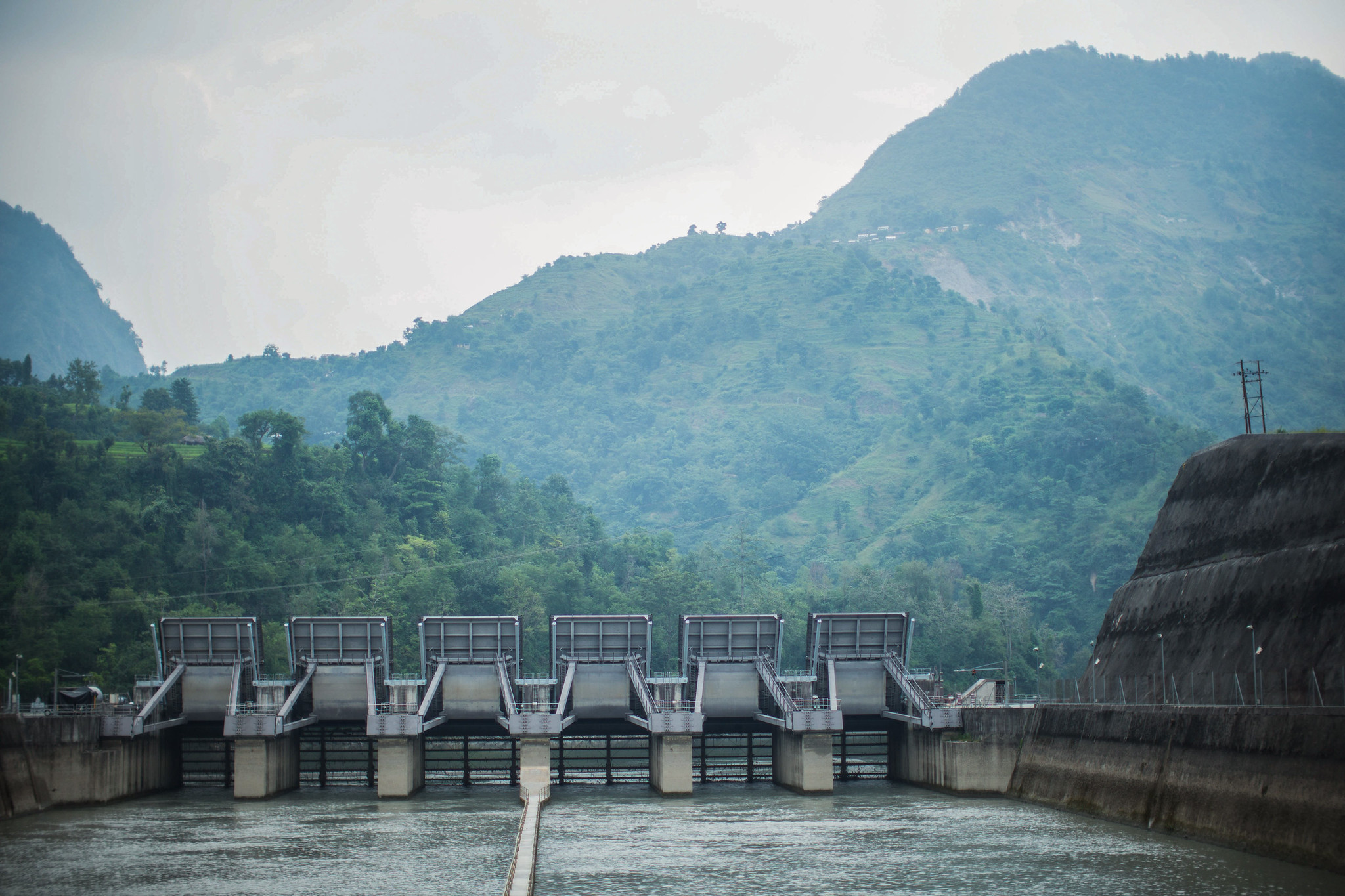
Upper Tamakoshi is a 456 MW peaking run-of-river plant in Dolakha District, roughly 200 km east of Kathmandu. It draws on an 822 m gross head — an exceptionally steep drop for a run-of-river scheme — through a headrace tunnel of roughly 7.9 km, feeding six Pelton turbines in an underground powerhouse. The project entered commercial operation in 2021 after a construction period stretched by the 2015 earthquake and pandemic-era labor disruptions, and it remains domestically financed, developed through Upper Tamakoshi Hydropower Limited, an NEA-established entity jointly held with Nepal Telecom, Citizen Investment Trust, and Rastriya Beema Sansthan.
The plant’s most instructive recent chapter has nothing to do with turbines or transformers. In September 2024, a landslide struck the headworks area, damaging the desanding basins, an underground culvert, and the control room — a reminder that in Himalayan hydel schemes, geotechnical risk upstream of the powerhouse can matter as much as electromechanical risk inside it.
The plant was offline for roughly 115 days before partial recommissioning began in December 2024, and by mid-2025 it had returned to full 456 MW round-the-clock output even during monsoon sediment loading, following partial repair of both desanders. Full permanent reconstruction continued in parallel with operations — an approach that traded some technical risk for continuity of national supply, given that Upper Tamakoshi alone can equal roughly two-thirds of Nepal’s power generation at full output.
For engineers evaluating similar terrain-exposed schemes elsewhere, the plant’s power purchase agreement terms are also a useful reference point: the design discharge is capped at 66 m³/s, with a contractual shutdown trigger if river flow exceeds 250 m³/s — a hard limit that held even when actual flow during the 2024 event reportedly reached several times the design discharge.
Upper Karnali: The 900 MW Trilateral Case Study
Upper Karnali, on the Karnali River in Nepal’s Achham and Dailekh districts, has taken a longer road. First proposed in 2006 and awarded to GMR Group in 2008, the 900 MW run-of-river project spent nearly two decades navigating financing before reaching a construction milestone in mid-2025, when tenders were issued for access-road tunneling, a river-crossing bridge, and headworks access roads. Full completion — dam, headrace tunnel, powerhouse, and electromechanical works — is now targeted for 2031, developed under a build-own-operate-transfer structure with a 25-year concession period following commissioning.
The ownership structure itself is a case study in cross-border project finance: GMR and India’s SJVN each hold roughly a third of the joint venture, with the Indian Renewable Energy Development Agency (IREDA) and Nepal Electricity Authority making up the balance — NEA’s 27% stake secured as free equity under the original government agreement. The project was also structured, at the outset, as a three-country power-trade arrangement: a portion for Nepal, a portion for India, and a planned 500 MW export to Bangladesh under a power purchase agreement initialled in late 2024.
That Bangladesh component was subsequently suspended under a change in Bangladesh’s power-procurement policy — a development worth noting for engineers assessing cross-border PPA risk on any multi-country hydel export scheme, independent of the politics behind it.
Technically, Upper Karnali is notable for requiring a comparatively short 2.4 km headrace tunnel relative to its 900 MW capacity, which is part of why it is considered one of the lower-cost large hydel developments globally on a per-MW basis — a useful data point when benchmarking tunnel-to-capacity ratios against other run-of-river schemes in the region.
What the Trilogy Shows
Read together with Upper Trishuli-1 — signed in 2012, financially closed in 2019, targeting a 2027 COD after a 15-year development cycle, and expected to deliver only about 38.75% of its output during Nepal’s dry season — the three projects trace the full lifecycle of a hydel asset in mountainous, seismically active terrain: multi-decade financial closure timelines, steep-head run-of-river design as the dominant typology, sediment and landslide management as an operational reality rather than a design footnote, and cross-border power trade as both an opportunity and a variable that can shift after financial close.
Nepal’s broader licensing framework is also moving. A government committee proposal floated in mid-2026 would shift future project allocation from a first-come-first-served basis toward competitive bidding — a structural change that, if adopted, would affect how the next generation of projects behind this trilogy gets allocated and financed.
For engineers benchmarking Himalayan hydel development against other high-head, tunnel-heavy run-of-river schemes elsewhere in the world, Nepal’s pipeline offers a compact, well-documented reference set.
For more field tested knowledge on hydropower engineering explore our complete guides on Hydropower Commissioning, How Do Hydropower Plants Work and What is Hydel Power.Turbine Selection Chart — Head vs Flow Calculator | Hydel Energy