Grand Inga Hydropower Project — Africa’s 44,000MW Dream and the Engineering Reality
The Grand Inga Hydropower Project on the Congo River in the Democratic Republic of Congo is the most ambitious hydel development in human history. With a potential capacity of 44,000MW — nearly twice the output of China’s Three Gorges Dam — Grand Inga could theoretically power the entire African continent. Yet today the existing Inga complex generates less than 2,000MW — under 5% of its potential. This is the story of the world’s greatest untapped hydel resource — the engineering potential, the political reality, the financing challenges and what Grand Inga means for Africa’s energy future.
What is the Grand Inga Hydropower Project?
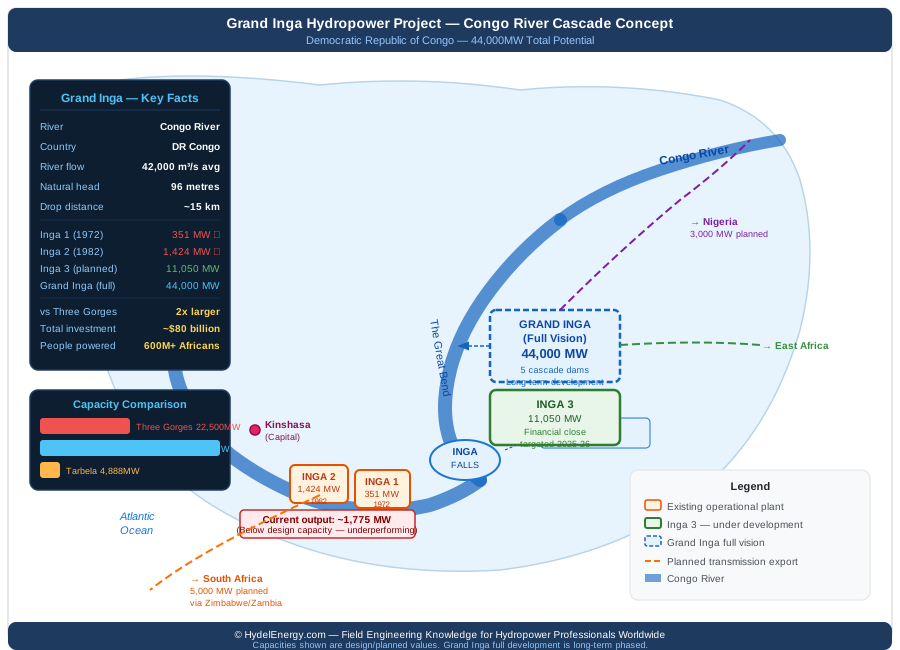
Grand Inga https://en.wikipedia.org/wiki/Grand_Inga_Dam is a proposed massive expansion of the existing Inga hydroelectric complex located on the Congo River in Kongo Central province, Democratic Republic of Congo. The Congo River carries the second largest water volume of any river on earth — second only to the Amazon — and drops 96 metres over a short distance at the Inga Falls site, creating one of the most extraordinary natural hydel resources ever identified.
The existing complex comprises two operational plants — Inga 1 commissioned in 1972 with 351MW capacity and Inga 2 commissioned in 1982 with 1,424MW capacity. Both plants are operating significantly below their design capacity due to decades of inadequate maintenance, equipment deterioration and operational challenges. The Grand Inga expansion project proposes developing the full 44,000MW potential of the site in phases — transforming the Congo River’s extraordinary hydraulic energy into electricity for DRC, sub-Saharan Africa and potentially beyond.
The Engineering Potential — Why Grand Inga Hydropower Project 44,000MW Is Realistic
From a pure engineering perspective the Grand Inga site is extraordinary. The Congo River at Inga Falls has an average flow of approximately 42,000 cubic metres per second — one of the highest sustained river flows on earth. Combined with a natural head of 96 metres over a relatively short distance, the hydraulic power available at this single site is genuinely exceptional. For comparison — Pakistan’s entire developed hydel capacity is approximately 10,000MW across dozens of projects on multiple rivers spanning thousands of kilometres. Grand Inga alone could deliver four times that capacity from a single river at a single location. The Three Gorges Dam — currently the world’s largest operating power station — generates 22,500MW https://en.wikipedia.org/wiki/Three_Gorges_Dam.
Grand Inga at full development would generate nearly double that from the same basic engineering principle — water falling through turbines connected to generators. The engineering challenge at Grand Inga is not the resource — that is beyond question. The challenge is the scale of civil works, mechanical installation, electrical systems and transmission infrastructure required to harness it — in one of the most remote and logistically challenging locations on earth.
The Phased Development Plan — Inga 3 First
Recognizing the enormous scale and complexity of full Grand Inga development, the project has been structured in phases. Inga 3 is the first major expansion phase — currently the focus of international development efforts. The Inga 3 concept was revised in 2018 from an original 4,800MW design to 11,050MW — making it alone larger than any single hydel project currently operating in Africa. Financial close for Inga 3 is targeted for 2025-2026 with construction expected to take 8 to 10 years after financing is secured.
The planned power allocation for Inga 3 output reflects the enormous regional demand — South Africa has expressed interest in receiving 5,000MW, Nigeria 3,000MW, mining companies operating in DRC 1,300MW and the remainder for DRC’s national utility SNEL. South Africa is actively negotiating transmission routing through Zimbabwe and Zambia to connect Inga 3 output to its national grid — a transmission line of over 3,000 kilometres that would itself be one of the longest power transmission infrastructure projects ever undertaken in Africa. Beyond Inga 3 — subsequent phases would progressively develop the remaining potential toward the full 44,000MW vision over decades.
The Financing Challenge — Why Grand Inga Hydropower Project Has Stalled For Decades
Grand Inga has been discussed, studied, planned and replanned for over 50 years. The fundamental obstacle has never been engineering — it has always been financing and governance. The total investment required for full Grand Inga development is estimated at $80 billion — making it one of the most expensive infrastructure projects ever conceived. Even Inga 3 alone requires $18 billion including $4 billion for transmission infrastructure. The financing structure is complex — requiring a combination of public funding from the DRC government, development finance institutions including the World Bank and African Development Bank, bilateral lenders, and private sector participation.
The World Bank has been involved in Inga planning for decades and in June 2025 announced support for the first phase of the Inga 3 Development Program — focusing initially on local community development for 1.2 million people living near the site before major construction begins. Political instability in DRC has repeatedly disrupted financing negotiations. Multiple international consortiums have engaged and withdrawn over the years. A Chinese and Spanish consortium signed an agreement in 2018 to undertake technical studies for Inga 3 — but progress has been slow.
The gap between Grand Inga’s extraordinary engineering potential and its tortured development history reflects the fundamental challenge of developing massive infrastructure in fragile state environments.
The AI Data Centre Angle — A New Development Narrative
A genuinely new development emerged in October 2025 that could change Grand Inga’s financing trajectory. The DRC government began actively pitching Grand Inga as a source of cheap clean electricity for AI data centres — targeting the enormous and rapidly growing global demand for reliable low cost power driven by artificial intelligence infrastructure expansion. The logic is compelling. AI data centres require massive amounts of continuous reliable electricity — exactly what Grand Inga’s firm baseload hydel generation would provide. Clean renewable hydel power addresses the sustainability requirements that major technology companies are committed to meeting for their data centre operations.
The DRC government’s Agency for the Development and Promotion of Grand Inga has been actively engaging data centre operators about potential power purchase agreements that could provide the anchor demand needed to unlock project financing. This represents a significant shift in the Grand Inga narrative — from purely an African energy poverty solution to a global clean energy infrastructure play. Whether this new angle will succeed where previous development efforts have stalled remains to be seen. But the intersection of Africa’s greatest untapped hydel resource with the world’s fastest growing electricity demand from AI infrastructure is a genuinely interesting new development chapter for Grand Inga.
What Grand Inga Means For Africa’s Energy Future
The stakes of Grand Inga development extend far beyond electricity generation statistics. The Democratic Republic of Congo is among the five poorest nations on earth — yet only one in five Congolese citizens has access to electricity. An estimated 73.5% of the population lives on less than $2.15 per day. Sub-Saharan Africa as a whole faces an electricity access crisis that is a fundamental brake on economic development, education, healthcare and poverty reduction. Grand Inga fully developed at 44,000MW could supply clean renewable electricity to over 600 million people across Africa — transforming the economic potential of an entire continent.
The Brookings Institution described Grand Inga in February 2026 as Africa’s greatest untapped economic engine and the single largest opportunity to end energy poverty on the continent. The transmission infrastructure required to distribute Grand Inga power across Africa — connecting national grids from DRC to South Africa, Nigeria, East Africa and beyond — would itself represent the most ambitious continental energy integration project ever attempted. For hydel engineers and power sector professionals working across Africa — Grand Inga is not just a project. It is the defining infrastructure challenge of our generation.
The Engineering Challenges — A Field Perspective
From a field engineering perspective Grand Inga presents challenges that dwarf anything currently operating in the global hydel sector. The scale of civil works required — diversion tunnels, powerhouse caverns, dam structures, penstocks — at 44,000MW capacity is simply without precedent in engineering history.
Underground powerhouse caverns for a project of this scale would be among the largest excavated spaces ever created by humans. The logistics of delivering and installing hundreds of generating units — turbines, generators, transformers, switchgear — in a remote location in central Africa with limited existing infrastructure presents supply chain and construction management challenges of extraordinary complexity. Transmission infrastructure connecting Inga to load centers across Africa involves thousands of kilometres of high voltage lines crossing multiple countries with varying regulatory frameworks, land acquisition challenges and security environments.
The existing Inga 1 and Inga 2 plants — currently generating well below design capacity due to decades of deferred maintenance — demonstrate what happens when hydel infrastructure of this complexity is not properly maintained and operated. Any Grand Inga expansion must address the operational and maintenance failures of the existing plants alongside developing new capacity. Getting Grand Inga right — engineering, financing, operations, community impact and environmental management — would be the greatest achievement in African infrastructure history. Getting it wrong would be a setback for African energy development that would take generations to overcome.
Conclusion — Africa’s 44,000MW Dream Needs Engineering Reality
Grand Inga is simultaneously the most inspiring and most frustrating project in global hydel development. The engineering potential is beyond question — 44,000MW of clean renewable electricity from one of the world’s greatest river systems is a genuine transformational opportunity for Africa and the world. The development reality has been decades of planning, financing negotiations, political complications and stalled progress.
What Grand Inga needs — beyond financing and political will — is engineering leadership. The technical complexity of developing 44,000MW in phases over decades requires world class hydel engineering expertise at every stage — site investigation, civil design, mechanical and electrical engineering, commissioning, operations and maintenance. The new AI data centre angle provides a potentially game changing financing narrative.
The World Bank’s June 2025 community development program provides a more sustainable social foundation. The South African transmission negotiations provide a critical anchor off-take arrangement. For the first time in years there is genuine momentum around Grand Inga. Whether that momentum translates into financial close on Inga 3 and the beginning of construction — or dissipates as previous efforts have — will be one of the defining stories of African infrastructure development in the coming decade. Hydel engineers worldwide will be watching.
For field tested hydel engineering knowledge explore our complete guides on How Do Hydropower Plants Work, – Is Hydel Energy Renewable and What Does Hydel Mean.