What “Water to Wire” Actually Includes — And What It Doesn’t
Every small hydro equipment supplier uses the same phrase. Water to wire. Single source of supply. Complete solution. One vendor even puts it as taking care of everything so you don’t have to.Read those pages as a field engineer and you come away with an impression: buy the package, and you have a power plant.
You do not. You have roughly a third of one.
This is not because vendors are lying. Every scope statement I have read is technically accurate. The problem is that the industry’s shorthand means something specific to the people who wrote it, and something much larger to the engineer reading it for the first time. Here is what the phrase actually means, what sits inside the boundary, what sits outside it, and what to ask before you commit.
The phrase, decoded
In “water to wire”:
| Water | Wire |
| means the turbine inlet flange. Not the river. Not the intake. The flange. | means the generator terminals, or at most the plant switchgear or the LV side of the step-up transformer. Not the grid connection point. |
That is the entire scope boundary, and once you see it, every vendor page reads differently.
Look at the language. ANDRITZ describes Compact Hydro as a single source for the entire electromechanical equipment — mini hydro from 20 to 3,000 kW at heads of 10 to 150 m, small hydro from around 500 kW to 30 MW at heads to 300 m. The word doing the work there is electromechanical. Siemens Energy lists its scope as turbines, generators, switchgear, transformers, switchboards and the plant control system. All equipment. Hydro Turbine Systems is more explicit still, scoping its integrated solution to the turbines, valves and trash rakes that it supplies. Norcan describes its range as running from the water connection to the grid wires — the connection, not the water.
Not one of those statements is misleading on its own terms. Together they describe a package that begins at a flange and ends at a terminal box.
What is inside the package
Typically supplied under a water-to-wire contract:
- Turbine and runner
- Main inlet valve or guard valve
- Speed governor and hydraulic power unit
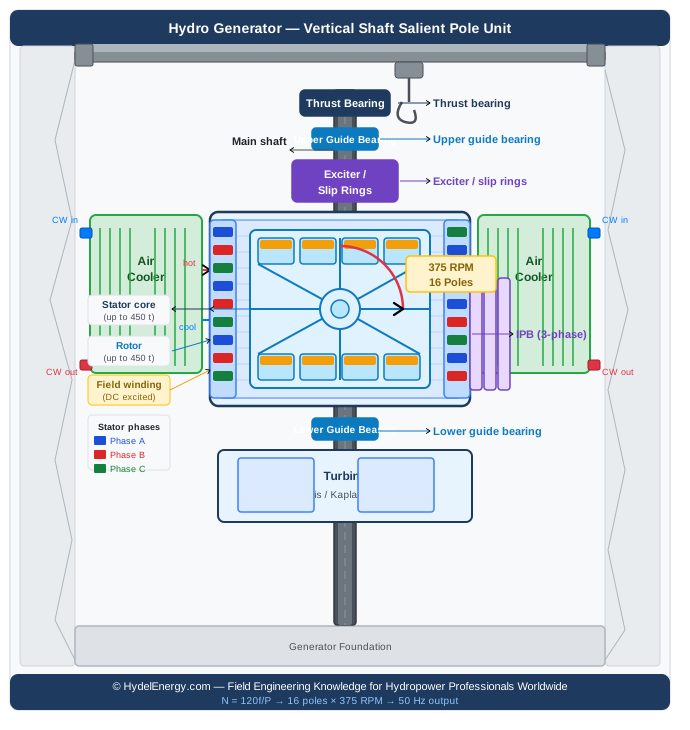
- Generator — often bought in from a third party, including PMG options
- Excitation system and AVR
- Control, protection and instrumentation panels
- Plant switchgear
- Step-up transformer
- Cooling, lubrication and drainage auxiliaries
- Mechanical and electrical balance of plant Erection, commissioning, performance testing and operator training
Some suppliers also include model testing and efficiency guarantees, which is worth having in writing.
For scale, a real 340 kW installation on an existing reservoir outlet consisted of a vertical-axis Kaplan with adjustable blades, three roller gates, a 400 kW induction generator at 220/380 V, a 500 kVA step-up transformer to 20 kV, and a PLC handling control and instrumentation. That is a complete electromechanical scope for a plant of that size. It is a short list.
What is outside the package
Everything that makes the water arrive at the flange, and everything that carries the power away from the terminals:
- Hydrological survey, flow gauging and flow duration analysis
- Intake structure and diversion weir
- Desanding basin or settling chamber
- Headrace channel or tunnel
- Forebay, spillway and trash rack structure
- Penstock, anchor blocks and thrust blocks
- Powerhouse building and foundations
- Tailrace and outlet works
- Access road
- Transmission line and grid interconnection
- Land acquisition
- Water use allocation and environmental clearance
- Civil design, geotechnical investigation and construction supervision
On a typical stream site, that second list carries somewhere between half and two thirds of total project cost. Civil works dominate small hydro economics, and civil works are almost entirely site-specific — which is exactly why published cost-per-kW figures for small hydro range across a factor of five and never agree with each other.
This is the single most useful thing to understand about small hydro budgeting. The equipment price is the knowable part. It is also the smaller part.
Why the confusion persists
Standardisation is real and it is genuinely valuable. Pre-designed modular units, workshop-tested before shipment, dimensioned for transport, installed in weeks rather than months — that is a significant advance over bespoke design for every site, and it has brought equipment costs down.
But standardisation stops at the flange, because it has to. You can standardise a turbine-generator set. You cannot standardise an intake on a boulder-bed mountain stream, or a penstock alignment across unstable slope, or a desander sized for glacial sediment load.
So the vendor standardises what can be standardised, describes it accurately as a complete electromechanical package, and markets it with language that sounds like a plant. The gap between those two things is where developers lose their budget.
Questions to ask before you sign
Take these to any water-to-wire quotation:
- Where does your scope start and end, physically? Ask for the terminal points by name — inlet flange, generator terminals, transformer HV bushings. Get it in the contract, not the brochure.
- Is the generator yours or bought in? Several suppliers integrate third-party generators. That affects warranty routing and spares lead time.
- Who does the hydraulic design of the penstock? Surge and water hammer analysis often falls in a gap between the civil designer and the equipment supplier. Establish ownership.
- What net head and design flow are the guarantees written against? Efficiency guarantees are meaningless without stated reference conditions.
- What happens at part load? Ask for the efficiency curve, not the peak figure. Stream flow varies all year; your plant will spend most of its life off design point.
- Is the generator capable of isolated operation? Standard for off-grid sites, but confirm it — synchronous machines suited to islanded running are specified differently from grid-following induction sets.
- What is excluded that I will need? Ask directly. A good supplier will tell you plainly, and the answer tells you a great deal about who you are dealing with.
- What are the sediment assumptions? Runner material and coating specification should reference expected suspended sediment load. On Himalayan and Andean streams this is not a detail.
The point
None of this is an argument against water-to-wire packages. For most small schemes they are the right procurement route — single point of responsibility on the equipment, tested before it ships, and far cheaper than bespoke engineering.
The argument is against reading the phrase as a description of a finished plant. It describes a boundary, and the boundary sits at a flange.
Budget for what is outside it, and the package will serve you well. Budget only for the package, and you will discover the civil works the expensive way.
Related: Hydropower Calculator — estimate output from your net head and flow. Turbine Selection Chart — find which runner type suits your duty. Hydro Generator — Complete Engineering Guide.