Solar Hydropower Integration— Partners or Rivals? The Engineering Reality of Solar Hydropower Grid Integration
Solar Hydropower Integration. Solar energy and hydropower are the two oldest and most abundant renewable energy sources on earth — yet their relationship is more complex than most energy commentary acknowledges. As solar installations accelerate globally, reaching costs that make it the cheapest electricity source in history, hydropower’s role in national grids is being fundamentally reshaped. In some markets solar is threatening the financial viability of planned hydel projects. In others it is making existing hydel infrastructure more valuable than ever. Understanding the engineering reality of solar and hydropower grid integration — how each affects the other, where they conflict and where they complement — is one of the most important questions in global energy development right now.
How Solar Changed the Grid — The Context Every Hydel Engineer Needs
Solar photovoltaic costs have fallen approximately 90% over the past decade — faster than almost any technology in energy history. What was an expensive niche technology in 2010 is now the cheapest source of new electricity generation in most of the world. The consequences of this cost collapse for national grids are profound and still unfolding. Solar generation is concentrated in daylight hours — peaking around midday and dropping to zero at sunset. As solar penetration increases on any grid, this concentration creates a specific and well-documented grid management challenge that directly affects how every other generation source — including hydropower — must operate.
Global installed hydropower capacity reached 1,469 GW in 2025 according to the International Hydropower Association’s 2026 World Hydropower Outlook — the most comprehensive annual review of the sector. Pumped storage hydropower surpassed 200 GW globally for the first time in 2025, with a record 11.7 GW added in a single year. These numbers tell a specific story — as solar expands, the world is simultaneously investing in pumped storage hydropower at record rates. That is not a coincidence. It is the market’s answer to the grid integration challenge that solar creates.
The Duck Curve — Solar’s Grid Management Problem
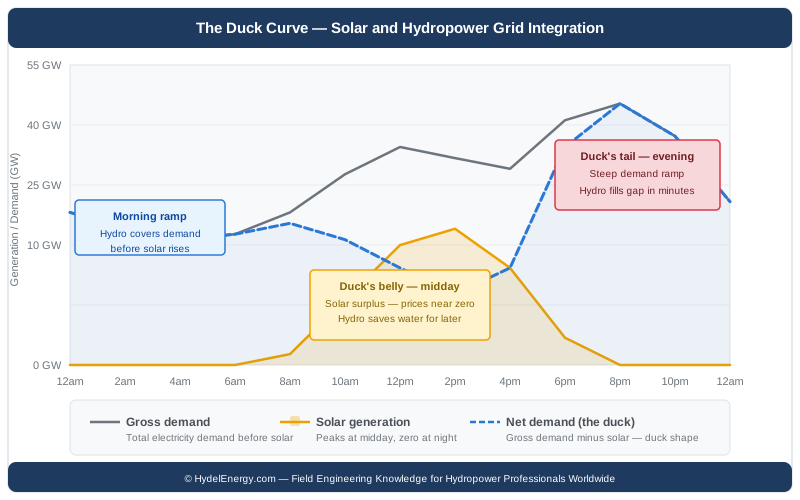
The Duck Curve is the single most important concept for understanding how solar affects hydropower operations. It was first identified by the California Independent System Operator in 2013 and has since become the defining grid management challenge for every electricity system with significant solar penetration.
The Duck Curve describes the daily pattern of net electricity demand — total demand minus solar generation — on a grid with high solar penetration. In the early morning before sunrise, net demand is high and rising as the day begins. As solar generation ramps up through the morning, net demand drops — sometimes sharply — through the middle of the day when solar is at its peak. Then as the sun sets in the late afternoon and evening, solar generation collapses while human electricity demand peaks — people returning home, cooking, lighting, air conditioning — creating a steep and rapid ramp in net demand that the remaining generation fleet must supply within a very short time window.
Plot this pattern on a graph and the shape resembles a duck — a high head in the morning, a deep belly through the middle of the day and a steep tail rising sharply in the evening. The duck’s belly is the period of solar surplus — when solar is generating more power than the grid needs and other generators must back off or curtail. The duck’s tail is the evening ramp — when solar disappears and the grid needs fast, flexible generation to fill the gap immediately.
From a hydropower engineering perspective the Duck Curve creates two distinct operational realities. During the belly — midday solar surplus — hydel plants with reservoirs reduce generation and store water, effectively saving hydraulic energy for later. Run of river plants without storage face a more difficult situation — they must generate when water flows regardless of grid conditions, and during periods of solar surplus their output may be curtailed or priced at near-zero market rates. During the tail — the evening ramp — storage hydel is uniquely valuable. No other renewable energy source can respond as rapidly and reliably as a hydel
How Solar Hurts Conventional Hydropower — The Economic Reality
The impact of solar on hydropower is not uniform — it depends critically on whether the hydel plant has water storage capability, how the plant’s power purchase agreement is structured and what the grid’s overall solar penetration level has reached. But for a significant category of hydropower projects — particularly run of river plants without meaningful storage — the economic impact of high solar penetration is genuinely damaging.
The core problem is tariff compression. In electricity markets where wholesale prices reflect real-time supply and demand, high solar penetration drives midday electricity prices toward zero — and in some markets into negative territory, where generators actually pay to stay connected rather than receive payment. A run of river hydel plant that generates primarily during daylight hours — when river flows are highest due to snowmelt and rainfall patterns — finds its most productive generation hours coinciding precisely with the hours when solar has made electricity prices lowest. The financial model that justified the project’s construction assumed a stable revenue stream. Solar has restructured the revenue profile in ways the original feasibility study never anticipated.
Pakistan provides the most immediate and dramatic current example. In July 2026 PPIB — the Private Power and Infrastructure Board — announced it was likely to shelve 1,832MW of planned hydel IPP capacity including Kohala at 1,124MW and Azad Pattan at 700.7MW. Both projects had held Letters of Support for over a decade — Kohala since December 2015, Azad Pattan since June 2016 — yet neither reached financial close. The immediate trigger was exclusion from Pakistan’s Indicative Generation Capacity Expansion Plan 2025-2035 due to reduced electricity demand projections driven by rapid rooftop solar growth. Pakistan’s rooftop solar installations have expanded fast enough that the system no longer needs the generation these projects would provide at the times they would provide it. A Letter of Support issued in 2015 assumed a grid that no longer exists in 2026.
This is not a Pakistan-specific phenomenon. California’s major hydel operators including Shasta and Oroville dams have fundamentally changed their operational patterns — reducing midday generation and increasing evening peaking — in direct response to the Duck Curve created by California’s massive solar expansion. Revenue from hydel generation in California has shifted from consistent baseload income to concentrated evening peak income, requiring financial model adjustments for projects originally designed for different operational profiles.
How Solar Helps Hydropower — The Engineering Opportunity
The relationship between solar and hydropower is not purely adversarial. For storage hydel plants with reservoirs, high solar penetration creates genuine operational and financial opportunities that did not exist before solar became a major grid contributor.
The most direct benefit is water conservation during solar hours. When solar generation is supplying the grid’s midday demand, a storage hydel plant can reduce its generation output and allow its reservoir to fill — effectively storing hydraulic energy that would otherwise have been converted to electricity at the lowest-value time of day. That stored water can then be released during the evening peak — when solar has disappeared and grid demand is highest — generating electricity at the most valuable time of day.
The same physical water produces more revenue when dispatched strategically around solar generation than when released continuously as baseload. Storage hydel operators in markets with high solar penetration are discovering that their reservoirs have become more valuable, not less, because solar has created a high-value window in the evening that only flexible dispatchable generation can fill.
Hybrid solar-hydro development is the most direct expression of solar and hydropower complementarity. Co-locating solar panels within a hydel project’s catchment area or on reservoir surfaces allows both technologies to share transmission infrastructure — the single largest cost element for remote hydel projects. The solar panels generate during daylight hours while the hydel plant conserves water.
The hydel plant generates in the evening while solar is unavailable. The shared transmission line carries generation from one source or the other at virtually all hours of the day — dramatically improving the utilization and therefore the economics of the transmission investment. China is developing this model at scale — integrating hydro, wind and solar across shared transmission corridors in Sichuan, Yunnan and Qinghai provinces as part of a deliberate national strategy.
Norway demonstrates the mature expression of this complementarity at national scale. With approximately 90% of its electricity generation from hydropower, Norway has become a flexibility exporter to neighboring Denmark and Germany as those countries expand wind and solar. When Danish wind is generating surplus power, it flows to Norway — effectively pumping water uphill by displacing Norwegian hydel generation. When Danish wind drops, Norwegian hydel fills the gap. The interconnected Nordic grid uses Norwegian reservoirs as a virtual battery for the entire region’s variable renewable generation — a role that makes Norwegian hydel more strategically valuable as Danish and German solar and wind expand.
Pumped Storage Hydropower — The Water Battery the World Is Building
Pumped storage hydropower is the technology that most directly answers the grid integration challenge that solar creates — and the global investment data confirms that the world has recognized this. Pumped storage capacity surpassed 200 GW globally for the first time in 2025, with a record 11.7 GW added in a single year according to the IHA 2026 World Hydropower Outlook. China alone has over 218 GW of pumped storage under construction — a scale of investment that reflects a deliberate national strategy to build the storage backbone for a grid increasingly dominated by solar and wind.
The engineering principle of pumped storage is straightforward. During periods of surplus generation — when solar is flooding the grid at midday and electricity prices are low or negative — pumped storage units reverse their turbines and operate as pumps, consuming electricity to move water from a lower reservoir to an upper reservoir. During periods of high demand — the evening peak when solar has disappeared — the stored water is released back through the turbines to generate electricity at peak tariff rates. The price arbitrage between the cost of pumping electricity and the revenue from generating electricity at peak is the fundamental financial driver of pumped storage economics.
What makes pumped storage uniquely valuable is not just its storage capability but its response speed. A large pumped storage plant can go from zero to full generation output in minutes — faster than any thermal plant and comparable only to open cycle gas turbines. As solar penetration increases and the evening ramp becomes steeper and faster, this response speed becomes increasingly critical. The grid needs generation that can follow the ramp precisely — adding megawatts at exactly the rate demand requires as solar drops. Pumped storage hydel is currently the only technology that can provide this combination of response speed, capacity scale and multi-hour duration at the scale national grids require.
India’s response to this recognition is the most ambitious pumped storage program outside China. The Central Electricity Authority’s January 2026 roadmap targets 100 GW of pumped storage capacity by 2035-36 — up from approximately 4.8 GW currently installed. This target is explicitly driven by India’s rapid solar expansion and the grid flexibility requirements that solar penetration creates. Australia’s Snowy 2.0 project — 2,000 MW of new pumped storage capacity in the Snowy Mountains — is similarly motivated by the need to balance rooftop solar generation that has expanded faster than grid planners anticipated. Cambodia’s Upper Tatay project — 1,000 MW of pumped storage, the first gigawatt-scale PSH in Southeast Asia — began construction in April 2026, directly positioned to balance Cambodia’s expanding solar generation.
Pakistan stands as a notable absence from this global pumped storage construction wave. Despite having some of the most technically suitable terrain for pumped storage development in the world — the steep elevation gradients of the Himalayas, Karakoram and Hindu Kush ranges offer exceptional head for pumped storage sites within reasonable distance of load centers — Pakistan has essentially zero pumped storage capacity installed or under active development. As Pakistan’s rooftop solar expansion continues to reshape the grid and render conventional run of river hydel projects less financially viable, the absence of pumped storage development represents a significant strategic gap in the country’s energy planning.
International Examples — How Countries Are Managing Solar-Hydro Integration
The solar-hydro integration challenge is playing out differently across different countries depending on their grid composition, hydro resource base and policy framework. Five international examples illustrate the range of responses.
1). China — Integration at Unprecedented Scale
China is executing the world’s most ambitious solar-hydro integration program. With over 300 GW of hydropower under construction — including 218 GW of pumped storage — China is simultaneously the world’s largest hydro generator and the world’s largest solar installer. The integration strategy is deliberate — hydro-wind-solar complementarity across shared transmission corridors, with pumped storage providing the flexibility backbone. Sichuan and Yunnan provinces combine massive hydro capacity with expanding wind and solar, using coordinated dispatch to maximize renewable utilization and minimize curtailment. The scale of China’s pumped storage construction program — 218 GW under construction — is larger than the entire installed pumped storage capacity of the rest of the world combined.
2). California — Where the Duck Curve Was Born
California’s electricity system first identified and named the Duck Curve in 2013 — and has spent the subsequent decade managing its consequences. The state’s major hydro facilities including Shasta Dam and Oroville Dam have fundamentally shifted their operational patterns from consistent baseload generation to concentrated evening peaking, following the solar generation profile precisely. California’s experience demonstrates both the operational challenge — managing a ramp of thousands of megawatts in the evening as solar drops — and the solution — flexible hydro storage is the most reliable and cost-effective tool available for managing that ramp at scale.
3). Australia — Snowy 2.0 and the Rooftop Solar Response
Australia has one of the world’s highest rooftop solar penetration rates per capita — and has responded with the Snowy 2.0 pumped storage project, adding 2,000 MW of new pumped storage capacity to the existing Snowy Mountains hydroelectric scheme. Snowy 2.0 is explicitly designed to store surplus rooftop solar generation during the day and release it during evening peaks when solar disappears. Australia’s experience is directly relevant to Pakistan and other developing countries facing rapid rooftop solar expansion — the answer to solar-driven grid instability is pumped storage hydro, not abandonment of either technology.
4). Norway — The Flexibility Exporter
Norway generates approximately 90% of its electricity from hydropower — giving it a unique position as a flexibility provider for the broader European grid. As Denmark and Germany expand wind and solar, Norwegian hydro reservoirs function as virtual batteries for the region — absorbing surplus renewable generation and releasing it on demand through interconnectors. Norwegian hydro operators have become sophisticated managers of cross-border energy flows, optimizing reservoir levels across seasons in response to solar and wind generation patterns across multiple countries. This model — hydro-rich countries providing flexibility services to solar and wind-rich neighbors — is increasingly relevant as cross-border grid integration expands across South Asia and Southeast Asia.
5). Pakistan — The Warning Signal
Pakistan’s July 2026 decision to shelve 1,832 MW of planned hydel IPP capacity — including Kohala 1,124 MW and Azad Pattan 700 MW — is the most direct warning signal for hydropower developers in any market experiencing rapid solar expansion. Both projects held Letters of Support from PPIB for over a decade yet never reached financial close. Their exclusion from the national capacity expansion plan due to reduced demand projections driven by rooftop solar growth demonstrates that solar penetration can fundamentally alter the grid economics that hydel projects depend on — within the lifetime of a single project development cycle. A hydel project whose feasibility study assumed a pre-solar grid may find itself commercially unviable by the time it reaches financial close in a post-solar grid. This is not a theoretical risk. It is happening in Pakistan right now.
What This Means For New Hydropower Projects — The Engineering Implications
The solar revolution has changed the engineering and financial requirements for new hydropower projects in ways that every developer, engineer and financier entering the sector must understand. The hydel project that made financial sense in 2010 may not make financial sense in 2026 — not because the engineering has changed but because the grid context it operates in has changed fundamentally.
Storage Is Now Essential, Not Optional
Run of river hydropower projects without meaningful water storage face increasing financial risk in grids with high solar penetration. Their generation profile — concentrated during daylight hours when river flows are highest — increasingly coincides with the period of lowest electricity value on solar-dominated grids. New run of river projects in markets with significant solar penetration must either demonstrate that their generation profile complements rather than conflicts with solar, include pondage or daily storage to shift generation toward evening peaks, or accept lower revenue projections that reflect solar-compressed daytime tariffs. Feasibility studies for new run of river projects that do not explicitly model the impact of projected solar penetration on revenue are not credible for financing purposes in 2026.
Grid Integration Study Is Now A Primary Feasibility Input
The grid connection study — already the most commonly neglected element of hydropower feasibility as discussed in our complete feasibility guide — has become even more critical in the solar era. It is no longer sufficient to identify the nearest connection point and estimate transmission line cost. The grid integration study for a new hydel project must now assess the existing and projected solar penetration on the connected grid, model the project’s dispatch profile against projected solar generation patterns, evaluate the grid’s need for the project’s specific generation characteristics — baseload, peaking or storage — and confirm that the project’s revenue model remains viable under realistic solar penetration projections for the plant’s operational lifetime. A project that cannot demonstrate grid integration value in a solar-dominated future grid will not receive financing from sophisticated lenders.
Pumped Storage Deserves Serious Evaluation
Every country with significant hydropower potential and expanding solar generation should be actively evaluating pumped storage development. The financial case for pumped storage improves directly with solar penetration — higher solar penetration creates larger price differentials between midday surplus and evening peak, improving pumped storage revenue. Countries like Pakistan that have exceptional pumped storage terrain — steep Himalayan gradients close to load centers — but no pumped storage development program are missing a strategic opportunity that will become increasingly valuable as solar expansion continues. The engineering and financial analysis of pumped storage potential should be incorporated into national energy planning frameworks alongside conventional hydel development.
Hybrid Solar-Hydel Development
Co-locating solar generation within hydel project catchments or on reservoir surfaces — sharing transmission infrastructure and optimizing complementary generation profiles — represents a genuinely compelling development model for remote hydel projects where transmission costs are a major financial burden. The shared transmission line carries solar generation during the day and hydel generation in the evening, dramatically improving asset utilization. Several major Chinese hydro-solar projects demonstrate the financial viability of this model at scale. For developers evaluating remote hydel sites in South Asia, Southeast Asia or Africa, hybrid solar-hydel development deserves serious feasibility assessment alongside conventional single-technology approaches.
Field Engineer’s Perspective — The Grid Question Is Now As Important As the Hydrology
A hydropower feasibility study conducted ten years ago asked primarily technical questions — how much water flows, how much head is available, what can be built and at what cost. A hydropower feasibility study conducted today must ask an additional set of questions that did not exist a decade ago — what is the current and projected solar penetration on the connected grid, how does the project’s generation profile interact with solar generation patterns, what grid services does the project provide that solar cannot, and will the project’s revenue model remain viable in a grid that looks fundamentally different in 2035 than it does today.
These are not questions that hydrologists or civil engineers answer. They are questions that require electrical engineers with grid integration understanding — engineers who know both the turbine and the transmission system, both the commissioning sequence and the capacity expansion plan. The hydropower engineer who understands only the powerhouse is increasingly at a disadvantage compared to the engineer who understands the powerhouse and the grid it connects to.
Fifteen years of field experience across major hydel projects has consistently shown that the projects which succeed long-term are those where every engineering discipline — civil, mechanical, electrical, hydrological — understands the complete system context. In the solar era that complete system context now extends beyond the project fence to include the grid’s generation mix, its storage capacity, its flexibility requirements and its trajectory over the next thirty years. The hydel project commissioned today will operate until 2075. The grid it operates on in 2075 will be unrecognizable compared to the grid of 2025. Designing and commissioning that project to serve the grid of 2075 — not just the grid of today — is the engineering challenge that defines the solar-hydro integration era.
Conclusion — Partners When Properly Integrated
Solar and hydropower are not rivals — they are complementary technologies whose combination, properly engineered and properly integrated, is more valuable than either alone. Solar provides abundant, low-cost daytime generation. Hydropower — particularly storage hydel and pumped storage — provides the flexibility, reliability and evening generation that solar cannot. The Duck Curve that solar creates is solved most elegantly and most cost-effectively by hydropower storage. The transmission infrastructure that remote hydel projects require is most economically justified when solar generation shares it.
The warning from Pakistan’s shelved 1,832 MW of hydel capacity is real — solar expansion can and does render conventional run of river hydel projects unviable in markets that develop solar faster than hydel planners anticipated. But the response from China, India, Australia and Norway is equally real — pumped storage hydropower is being built at record rates globally because solar expansion makes it more necessary and more financially attractive, not less. The world added a record 11.7 GW of pumped storage in 2025 alone. Global pumped storage capacity surpassed 200 GW for the first time. The water battery era has arrived.
For hydropower engineers, developers, financiers and policymakers — the solar revolution is not a threat to be defended against. It is a context to be understood, integrated and ultimately turned into an opportunity. The hydel project that understands its role in a solar-dominated grid and designs for that role from feasibility through commissioning and operation will not just survive the energy transition. It will be indispensable to it.
For more field tested knowledge on hydropower engineering and grid integration explore our complete guides on Hydropower Commissioning, Hydel Power Advantages and Disadvantages, Is Hydel Energy Renewable and What is Hydel Power.
What “Water to Wire” Actually Includes — And What It Doesn’t