AIS vs GIS Switchyard in Hydropower Plants — A Field Engineer’s Guide
The switchyard is where a hydropower plant connects to the outside world — the electrical interface between the generator and the transmission grid. Every megawatt a hydel plant produces passes through its switchyard on the way to the grid. The choice between an Air Insulated Switchyard (AIS) and a Gas Insulated Switchyard (GIS) is one of the most consequential decisions in hydel plant electrical design — affecting cost, footprint, reliability, maintenance and suitability for the specific site conditions that define hydropower projects. This guide compares AIS and GIS switchyards specifically in the context of hydropower plants — where remote mountain locations, high altitude, underground powerhouses and challenging environments make this choice fundamentally different from a typical urban substation decision.
What is a Switchyard — The Grid Interface of Every Hydel Plant
The switchyard is the collection of high voltage electrical equipment that connects a hydel (hydropower) plant’s generator output to the transmission grid. After the generator produces electricity at medium voltage and the main power transformer steps it up to transmission voltage — 132kV, 220kV, 500kV or higher — the switchyard is where that high voltage power is switched, protected, measured and dispatched onto the transmission lines that carry it to distant load centers. Every hydroelectric plant, regardless of size or location, requires a switchyard to disperse its power.
Every switchyard, whether air insulated or gas insulated, contains the same fundamental equipment performing the same functions. Circuit breakers interrupt current flow during faults and enable controlled switching of circuits. Disconnectors — also called isolators — provide visible isolation points for safe maintenance. Current transformers and voltage transformers measure the electrical quantities needed for metering and protection. Busbars are the common connection points where multiple circuits meet. Surge arresters protect equipment from lightning and switching overvoltages. Earthing switches provide safe grounding for maintenance. The difference between AIS and GIS is not what equipment does — it is the insulating medium that separates the live conductors from each other and from earth.
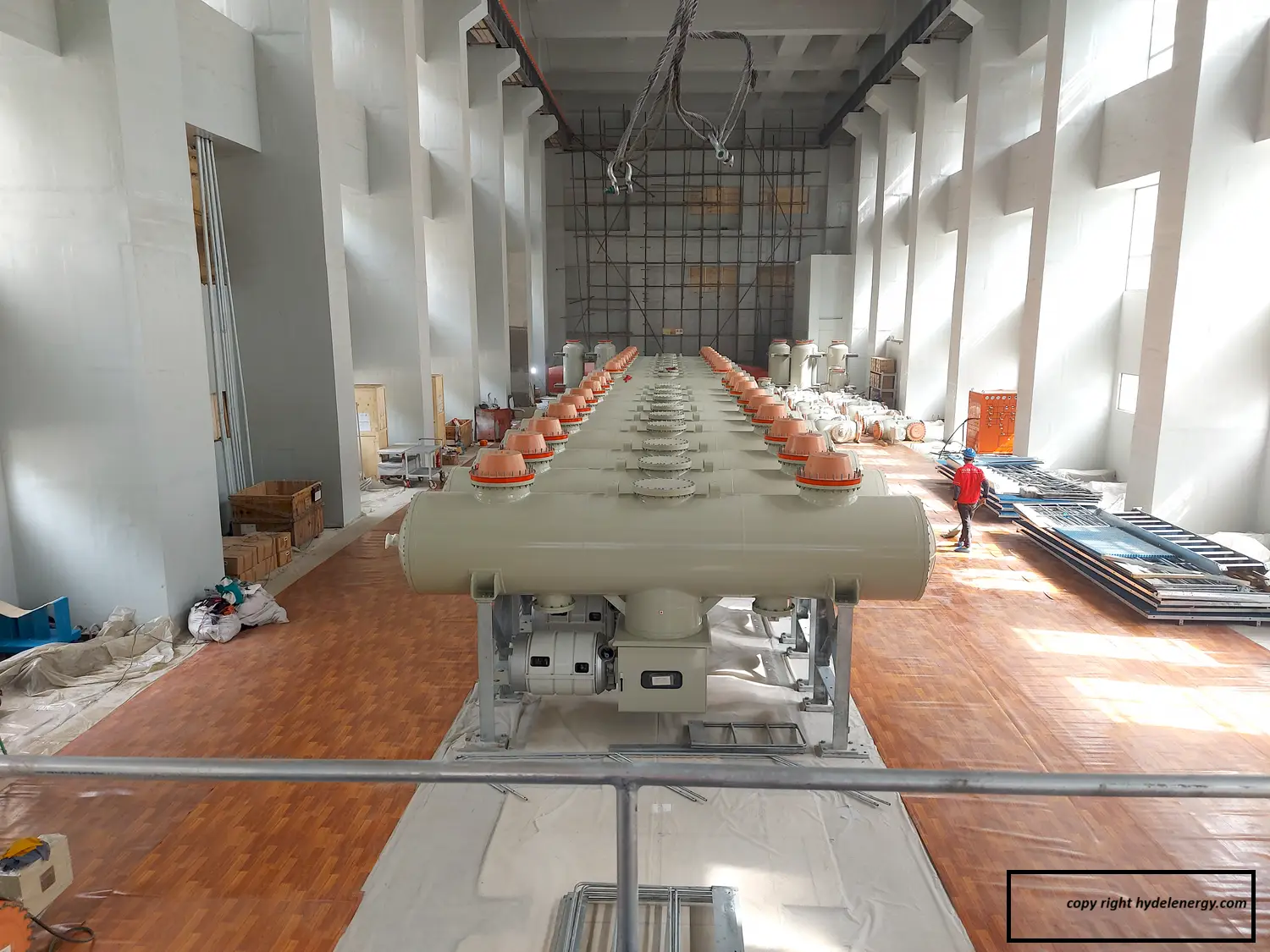
In an Air Insulated Switchyard the insulating medium is atmospheric air. Live conductors are separated by carefully calculated air clearances — the higher the voltage, the larger the required clearance. This is why AIS switchyards for high voltage hydel (hydropower) plants occupy large open areas with substantial physical spacing between equipment. In a Gas Insulated Switchyard the insulating medium is a gas with far higher dielectric strength than air — traditionally sulfur hexafluoride, SF6 — contained within sealed metal enclosures. Because the gas insulates far more effectively than air, the entire switchyard can be built dramatically more compact, with all live parts enclosed in grounded metal housings — a decisive advantage for the space-constrained sites typical of hydroelectric development.
AIS vs GIS — The Core Engineering Trade-Offs
The choice between AIS and GIS for a hydel (hydropower) switchyard involves a series of engineering trade-offs across space, cost, reliability, maintenance and environmental impact. No single technology wins on every measure — the right choice depends entirely on the specific conditions of each hydroelectric project.
Space and Footprint
Space is the single most decisive advantage of GIS. Because SF6 gas provides far higher dielectric strength than air, a GIS switchyard can be built up to ten times more compact than an equivalent AIS switchyard at the same voltage level. An AIS switchyard for a large hydel plant may occupy several hectares of open land, while an equivalent GIS installation can fit inside a single building a fraction of that size. For hydropower plants located in narrow mountain valleys — where flat, stable land is scarce and expensive to create — this compactness is frequently the deciding factor. Many Himalayan and Andean hydel projects have no realistic option for a sprawling AIS switchyard because the terrain simply does not offer the space.
Initial Cost
AIS wins decisively on initial capital cost. Air is free, and AIS equipment — using simple air-insulated busbars and conventional outdoor equipment — is significantly less expensive to manufacture and install than the precision-engineered sealed enclosures, gas handling systems and specialized components that GIS requires. For a hydel project with abundant flat land available at low cost, AIS is typically the more economical choice on initial investment alone. GIS carries a substantially higher upfront equipment and installation cost.
Lifecycle Cost
The lifecycle cost comparison is more nuanced and frequently reverses the initial cost advantage. GIS requires far less land — a major saving where land is expensive or must be created through excavation and slope stabilization in mountainous hydel terrain. GIS requires significantly less maintenance over its operational life. GIS is far less affected by environmental degradation. When the full lifecycle including land, maintenance and reliability is considered, GIS is often the more economical choice for hydel plants in challenging locations despite its higher initial cost — while AIS remains more economical overall for projects with cheap, abundant land and easy access.
Reliability and Environmental Resilience
GIS offers superior reliability in harsh environments precisely because its live parts are sealed inside grounded metal enclosures, completely isolated from the external environment. Salt-laden coastal air, industrial pollution, dust, moisture, snow and ice — all of which degrade the performance of exposed AIS equipment — have no effect on the sealed internals of a GIS installation. For hydel plants in coastal locations, heavily polluted areas, or regions with severe weather, this environmental sealing translates directly into higher reliability and fewer weather-related faults. AIS equipment, exposed to the atmosphere, is vulnerable to insulation degradation from all these environmental factors and requires larger clearances in polluted or humid conditions.
Why the AIS vs GIS Choice Is Different for Hydropower Plants
The AIS versus GIS decision for a hydel (hydropower) plant is fundamentally different from the same decision for a typical urban substation or thermal power plant. Hydropower plants are located where the water is — and the water is frequently in remote, mountainous, high altitude or environmentally challenging locations that dramatically shift the balance of the AIS versus GIS trade-off. Four hydropower-specific factors deserve particular attention.
High Altitude — Air Insulation Weakens
This is the factor most frequently overlooked in generic AIS versus GIS comparisons — and the one most relevant to mountain hydel development. Air insulation performance decreases with altitude. As atmospheric pressure drops at higher elevations, the dielectric strength of air decreases, meaning larger clearances are required to achieve the same insulation performance. For an AIS switchyard at a high altitude hydel site — common across the Himalayas, Karakoram, Andes and other major mountain hydel regions — this altitude derating requires even larger physical clearances, further increasing the already substantial footprint AIS demands. GIS, using sealed gas insulation at controlled pressure, is largely unaffected by altitude. For high altitude hydroelectric projects, this altitude effect strengthens the case for GIS considerably — both because AIS becomes even bulkier and because the reliability of sealed insulation is more predictable at elevation.
Underground Powerhouses — GIS Is Essential
Many large hydel plants are built with underground powerhouses — excavated caverns deep inside mountains, chosen for geological stability, reduced environmental impact or strategic protection. In an underground powerhouse the switchyard must often be located within the cavern complex itself or in a nearby underground chamber, where space is extremely constrained and every cubic metre of excavation carries enormous cost. In these conditions GIS is not merely preferable — it is frequently the only viable option. The compactness of GIS makes it possible to fit a complete high voltage switchyard inside a cavern where an AIS installation would be physically impossible. The sealed design also suits the enclosed, controlled environment of an underground powerhouse where an open air switchyard would face ventilation and humidity challenges.
Narrow Valley Sites — Space Constraints
Run of river hydel plants and many storage projects are located in narrow river valleys where flat, stable buildable land is genuinely scarce. Creating level ground for a sprawling AIS switchyard in such terrain may require extensive excavation, slope stabilization and retaining structures — adding significant cost and geological risk. The compact footprint of GIS often allows the switchyard to fit within the limited available space adjacent to the powerhouse without major additional site formation works. For hydroelectric projects in constrained valley terrain, the space efficiency of GIS frequently outweighs its higher initial equipment cost when the full cost of site formation for AIS is accounted for.
Coastal and Humid Environments
Hydel plants located near coastlines, in high-humidity tropical regions or in areas with significant airborne pollution face accelerated degradation of exposed AIS equipment. Salt deposition on insulators in coastal environments causes flashovers and requires frequent cleaning. High humidity reduces air insulation performance and accelerates corrosion. In these environments the sealed enclosures of GIS provide a decisive reliability advantage — the live parts never contact the corrosive external atmosphere. Many hydroelectric projects in coastal and tropical regions select GIS specifically for this environmental protection.
The SF6 Problem — Environmental Challenge and the Shift to Alternatives
The compactness and reliability of GIS have historically depended on sulfur hexafluoride — SF6 — an exceptional insulating gas with a serious environmental drawback. SF6 is the most potent greenhouse gas known, with a global warming potential approximately 23,500 times that of carbon dioxide, and it persists in the atmosphere for more than 3,000 years. Any SF6 that leaks from a GIS installation during operation, maintenance or end-of-life disposal contributes disproportionately to global warming. For a hydel (hydropower) plant — a renewable energy asset whose entire purpose is clean electricity generation — using a switchyard insulated with the most potent greenhouse gas known represents a genuine environmental contradiction.
This contradiction has driven significant regulatory and technological change. Regulators in the European Union, several US states including California, and increasingly worldwide are restricting SF6 use, requiring detailed leak monitoring, mandatory recordkeeping and imposing penalties for emissions. In response, major manufacturers including Siemens and Schneider have developed SF6-free switchgear using alternative insulating gases and gas mixtures that meet the same IEC 62271 performance standards while dramatically reducing or eliminating the global warming impact. These SF6-free alternatives have already been adopted in France, Germany, California and other jurisdictions with strict environmental regulations.
For hydel plant developers making switchyard decisions today, the SF6 issue adds an important dimension to the GIS choice. A GIS installation using traditional SF6 carries both an environmental liability and a growing regulatory compliance burden — leak monitoring, gas handling procedures, technician training and reporting requirements. The emerging SF6-free GIS technology offers the compactness and reliability advantages of GIS without the greenhouse gas liability, though often at higher cost and with a shorter track record. Developers of new hydroelectric projects should specifically evaluate SF6-free GIS options, particularly for projects in jurisdictions where SF6 regulations are tightening, as future-proofing against increasingly strict environmental compliance requirements.
SF6 Handling During Commissioning
For engineers commissioning a GIS switchyard at a hydel plant, SF6 handling is a specific and safety-critical activity. SF6 gas must be filled to precise density under controlled conditions, and gas density is continuously monitored during operation because insulation performance depends directly on maintaining correct gas density. During commissioning, every gas compartment must be filled, its density verified against specification and its sealing confirmed through leak detection. SF6 is heavier than air and displaces oxygen — creating an asphyxiation hazard in confined spaces, a particular concern in underground powerhouse switchyards where ventilation is limited.
Commissioning procedures require SF6 gas handling by trained technicians using proper gas handling equipment, with continuous atmospheric monitoring in enclosed areas. Decomposition products formed when SF6 is exposed to electrical arcing are toxic, requiring specific safety protocols when opening compartments that have experienced switching or fault arcing. These SF6 handling requirements are a genuine additional complexity of GIS commissioning that AIS does not involve.
Commissioning Differences — AIS vs GIS Switchyards
Commissioning an AIS switchyard and commissioning a GIS switchyard at a hydel (hydropower) plant involve different activities, different timelines and different risks. Understanding these differences is essential for anyone planning or executing hydel plant electrical commissioning.
AIS Commissioning
AIS switchyard commissioning benefits from complete visual access to all equipment. Every connection, every clearance, every insulator is visible and directly inspectable. Insulation resistance testing, contact resistance measurement of circuit breakers and disconnectors, current transformer and voltage transformer testing, and protection functional checks are all performed on accessible, visible equipment. Clearance verification — confirming that the physical air gaps between live parts meet the design requirements for the voltage level and site altitude — is a specific AIS commissioning activity with no GIS equivalent. Faults or errors discovered during AIS commissioning are generally straightforward to access and correct because everything is physically reachable.
GIS Commissioning
GIS switchyard commissioning is more complex and less forgiving because the equipment is sealed inside gas-filled enclosures with no visual access to the internals. SF6 gas filling and density verification for every compartment is a major commissioning activity unique to GIS. Gas leak testing confirms the integrity of every sealed compartment. Partial discharge testing is particularly critical for GIS — because internal defects cannot be visually inspected, partial discharge measurement is often the only way to detect manufacturing defects, contamination or assembly errors inside the sealed enclosures before energization.
Any defect discovered inside a GIS compartment after gas filling requires the compartment to be evacuated of gas, opened, corrected, resealed, evacuated and refilled — a far more involved process than correcting a visible AIS fault. This makes thorough factory acceptance testing and careful site assembly of GIS even more important, since site correction of internal defects is so costly and time-consuming.
Back Feeding Through the Switchyard
Regardless of whether a hydel plant uses AIS or GIS, the switchyard is energized first during commissioning through back feeding — receiving power from the grid through the transmission line before the generating units produce any electricity. As covered in our complete hydropower commissioning guide, this back feeding energizes the switchyard busbars at full transmission voltage, allowing the main transformer and station auxiliary systems to be powered from the grid before generation begins. For a GIS switchyard, this means all gas compartments must be filled, verified, leak-tested and their protection systems fully commissioned and armed before back feeding energizes the enclosed busbars. The sealed nature of GIS means there is no opportunity to visually verify the internal condition once the switchyard is energized — all verification must be complete beforehand.
How to Choose — AIS or GIS for a Hydropower Project
The choice between AIS and GIS for a specific hydel (hydropower) project comes down to matching the technology’s strengths to the project’s specific conditions. There is no universally correct answer — there is only the correct answer for each specific site.
Choose AIS When
Air Insulated Switchyard is typically the better choice when the hydel project has abundant, flat, stable land available at low cost — common for storage projects with large dam sites in open terrain. When initial capital cost is the dominant constraint and land is not expensive. When the site is at low to moderate altitude where air insulation performs well without excessive derating. When the environment is clean and dry, without significant salt, pollution or humidity challenges. When simple visual maintenance access and straightforward future expansion are priorities. When local technical capacity favors conventional air-insulated equipment over specialized gas handling expertise. Many large storage hydel plants in open valley or plateau terrain use AIS for these reasons.
Choose GIS When
Gas Insulated Switchyard is typically the better choice when the hydel project is space-constrained — narrow valleys, underground powerhouses, or sites where creating flat land is expensive and geologically challenging. When the project is at high altitude where air insulation requires excessive derating and enlarged clearances. When the powerhouse is underground, where GIS is frequently the only viable option. When the environment is harsh — coastal salt, industrial pollution, high humidity, severe weather — where sealed enclosures provide decisive reliability advantages. When long-term reliability and minimal maintenance are prioritized over lower initial cost. When land cost is high enough that the reduced GIS footprint delivers overall lifecycle savings. Most high altitude, underground and space-constrained hydroelectric projects select GIS for these reasons.
Hybrid Solutions
Mixed Technology Switchgear combines AIS and GIS elements in a single installation, allowing designers to balance cost, space and performance by using GIS for the most space-critical or environmentally exposed sections while retaining lower-cost AIS where conditions permit. For some hydel projects with mixed conditions across the site, a hybrid approach delivers the optimal balance between the low cost of AIS and the compactness and reliability of GIS.
Field Engineer’s Perspective on Switchyard Selection
The switchyard technology decision on a hydel (hydropower) project is made during feasibility and detailed design — but its consequences are felt through the entire operational life of the plant, and most directly by the engineers who commission and maintain it. A GIS switchyard commissioned correctly delivers decades of reliable, low-maintenance service in conditions that would challenge an AIS installation continuously. A GIS switchyard commissioned poorly — with an undetected internal defect, an inadequate gas seal or a partial discharge source missed during testing — creates problems that are far harder to diagnose and correct than any AIS fault, precisely because the equipment cannot be visually inspected once sealed and energized.
Across field experience on hydel projects, the switchyard choice consistently reflects the reality of the site rather than a theoretical preference. Remote high altitude projects in constrained mountain terrain gravitate toward GIS because the alternative is often physically impossible or prohibitively expensive to build. Large storage projects in open terrain with cheap land frequently retain AIS because the space penalty of air insulation carries no real cost at those sites. The best engineers approach the decision without ideology — matching the technology precisely to the altitude, the available space, the environment and the lifecycle economics of each specific hydroelectric project.
What matters most, regardless of which technology is selected, is commissioning it correctly. A switchyard is the single point through which every megawatt the plant produces must pass to reach the grid. A fault in the switchyard takes the entire plant offline regardless of how well the generators and turbines are performing. The rigor applied to switchyard commissioning — whether verifying air clearances on an AIS installation or verifying gas density and partial discharge on a GIS installation — directly determines the reliability of the plant’s connection to the grid for decades to come.
Conclusion
The choice between AIS and GIS switchyards for a hydel (hydropower) plant is a decision defined by site conditions — space, altitude, environment and lifecycle economics. AIS offers lower initial cost and simple maintenance where land is abundant and conditions are favorable. GIS offers compactness, reliability and environmental resilience that make it essential for the high altitude, underground and space-constrained sites where much of the world’s remaining hydroelectric potential is located. The emerging shift away from SF6 toward environmentally responsible insulating gases adds a new dimension to the GIS decision, particularly for renewable energy projects whose purpose is fundamentally at odds with using the most potent greenhouse gas known.
For hydel plant developers, engineers and operators, understanding the AIS versus GIS trade-off in the specific context of hydropower — not as a generic substation decision but as a hydroelectric-specific engineering choice shaped by mountains, altitude, water and remoteness — is essential to building plants that connect reliably to the grid for their full operational life.
For more field tested knowledge on hydropower engineering explore our complete guides on Hydropower Commissioning, Hydro Generator and How Do Hydropower Plants Work.
AIS and GIS switchyard Commissioning Protocol – Coming Soon
The complete Hydel Energy AIS and GIS Switchyard Commissioning Protocol — a field-ready document covering every test sequence, gas handling procedure, partial discharge verification, clearance check, protection functional test and sign-off requirement from equipment arrival through energization — is currently in development.
This is not a generic checklist compiled from manufacturer manuals. It is a practical, field-tested commissioning protocol built from direct experience commissioning both air insulated and gas insulated switchyards on major hydel (hydropower) projects — including the SF6 gas handling procedures, partial discharge testing requirements and back feeding sequences that determine whether a switchyard energizes safely or fails at the worst possible moment.
Register interest via the Connect page to be notified when the protocol becomes available. Turbine Selection Chart — Head vs Flow Calculator | Hydel Energy