Hydel (Hydropower) in India
India’s hydel power sector represents one of the most significant yet underdeveloped renewable energy opportunities in Asia. With an assessed hydel potential of 145,320MW and only 29% currently developed, India sits at a critical juncture in its energy transition. This guide covers India’s hydel power sector from an engineering perspective — current installed capacity, major river systems, the 78GW target for 2030 and the practical challenges facing further development.
Hydel (Hydropower) Power in India — Current Status
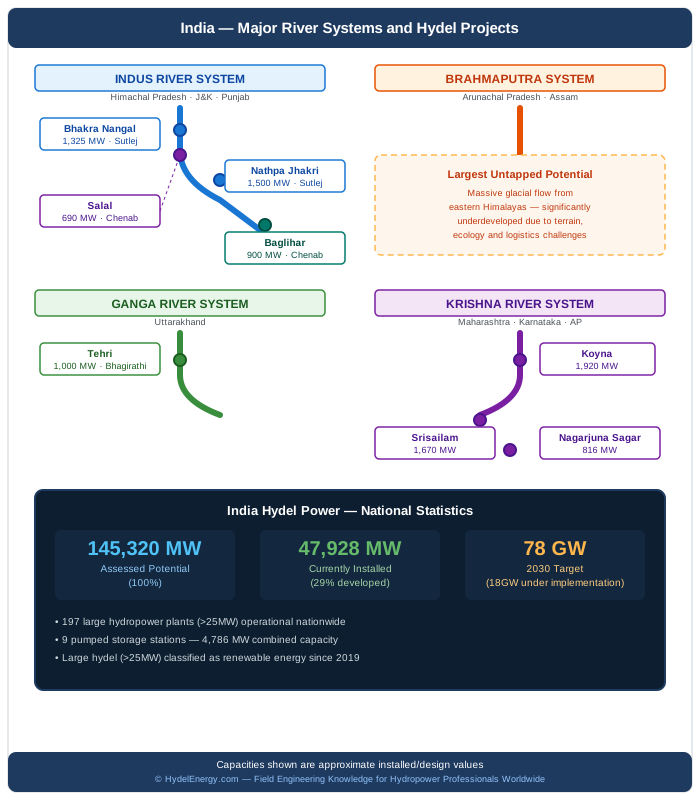
India’s total installed power generation capacity reached approximately 475,590MW as of May 2025. Large hydroelectric power plants account for approximately 47,928MW of this — close to 10% of total capacity — while total hydro capacity including small hydro and pumped storage reaches approximately 52.8GW according to Central Electricity Authority data. These figures are updated monthly by the CEA and may vary slightly depending on the exact reporting period.
. India’s assessed hydel potential stands at 145,320MW, of which approximately 42,105MW — 29% — has been developed, with a further 15,024MW currently under construction. The country operates 197 large hydropower plants above 25MW capacity and 9 pumped storage stations with a combined capacity of 4,786MW. A significant policy shift occurred in 2019 when large hydel projects above 25MW were officially classified as renewable energy — a classification that small hydel projects already held — unlocking incentives and policy support that had previously been reserved for solar and wind development only.
Major River Systems and Hydel (Hydropower) in india Development
India hydel (Hydropower) Power potential is concentrated across several major river systems, each presenting distinct engineering characteristics and development challenges.
The Indus River System
The Indus river system flowing through Himachal Pradesh, Jammu and Kashmir and Punjab hosts some of India’s most significant hydel projects including Bhakra Nangal and Nathpa Jhakri. This region benefits from high head sites in the western Himalayas with substantial glacial and snowmelt fed flow throughout the year.
The Brahmaputra River System
The Brahmaputra river system in Arunachal Pradesh and Assam represents India’s largest untapped hydel potential. The Northeast region’s hydel resources remain significantly underdeveloped due to challenging terrain, sensitive ecology and complex logistics, despite carrying enormous water volumes through the eastern Himalayas.
The Krishna and Ganga River Systems
The Krishna river system across Maharashtra, Karnataka and Andhra Pradesh hosts major projects including Koyna, Srisailam and Nagarjuna Sagar. The Ganga river system in Uttarakhand includes the significant Tehri project. These central and northern river systems have historically been among India’s most developed hydel regions due to relatively accessible terrain compared to the Himalayan northeast.
The 78GW Target — India’s Hydel (Hydropower) Roadmap to 2030
The Indian government has set a target of 78GW total hydel capacity by 2030, with approximately 18GW currently under implementation across various stages of development. Achieving this target requires sustained investment, faster project clearances and resolution of the structural challenges that have historically slowed hydel development in India. Grid integration is a central driver of this target — as India rapidly expands solar and wind capacity, hydel power’s unique ability to provide both flexible peaking generation and grid stability services becomes increasingly valuable. Pumped storage hydel — currently 4,786MW installed — is specifically prioritized for balancing variable renewable generation, with significant additional pumped storage capacity under development to support India’s broader renewable energy integration strategy.
A more recent and more specific target emerged in January 2026 when India’s Central Electricity Authority published a dedicated roadmap for pumped storage hydel development — targeting 100GW of pumped storage capacity by 2035-36, up from approximately 4.8GW currently installed. This represents one of the most ambitious pumped storage expansion programs anywhere in the world, reflecting pumped storage hydel’s growing strategic role in balancing India’s rapidly expanding solar and wind capacity. The International Hydropower Association’s 2026 World Hydropower Outlook specifically highlighted India as an emerging global leader in pumped storage development, noting that the broader South and Central Asian hydel development pipeline now exceeds 300GW across the region.
Development Challenges Facing Indian Hydel Projects
Despite enormous potential, India’s hydel sector faces persistent development challenges that have historically slowed capacity growth. Land acquisition processes, environmental clearance procedures and local community opposition frequently delay projects by years or even decades — a pattern consistent with hydel development challenges seen globally from Pakistan to Africa to Southeast Asia. Displacement and rehabilitation of affected communities remains a persistent and serious issue, with inadequate compensation and resettlement processes fueling social unrest and legal challenges on multiple major projects. Large hydel projects concentrated in seismically active and ecologically sensitive Himalayan zones face elevated disaster vulnerability — a critical engineering consideration following several high profile incidents affecting Himalayan hydel infrastructure in recent years. Currently only 32% of India’s assessed hydel potential has been harnessed, with the Northeast and Himalayan states remaining significantly underdeveloped relative to their resource potential — representing both the scale of the remaining opportunity and the scale of the engineering and developmental challenge ahead.
Climate Vulnerability — A Growing Concern
India’s hydel sector has experienced a clear demonstration of climate vulnerability in recent years. Hydel generation declined by 17.33% — from 162.05 billion units in FY23 to 133.97 billion units in FY24 — driven by reduced reservoir levels across major hydel installations. The Indira Sagar reservoir in Madhya Pradesh, supporting 1GW of hydel capacity, was reported at just 17% full — down from 24% the previous year. The Koyna Dam in Maharashtra, with 1.9GW capacity, was similarly running well below typical seasonal levels. This decline in hydel generation has direct knock-on effects across the energy system — reduced hydel output increases reliance on thermal generation, raising both costs and emissions, while industries with high water dependency face supply disruption risk. This pattern reinforces a broader truth applicable across the global hydel sector — hydel power is genuinely renewable, but its output is fundamentally dependent on hydrology and climate conditions that are increasingly variable. Engineers and planners developing India’s hydel sector must increasingly account for this climate variability in reservoir design, generation planning and grid integration strategy.
Field Engineer’s Perspective on Indian Hydel Development
India’s hydel sector shares striking similarities with Pakistan’s hydel development experience — Himalayan glacial catchments, high seismic risk terrain, complex resettlement requirements and a persistent gap between assessed potential and developed capacity. Both countries draw from the same broader Himalayan and Karakoram water resource — India’s Northeast hydel potential on the Brahmaputra system parallels Pakistan’s Indus basin development, just as Nepal’s emerging hydel export ambitions parallel both. The engineering challenges are fundamentally similar — underground powerhouse construction in fractured Himalayan rock, long headrace tunnels through seismically active zones, generator commissioning at high altitude remote sites and grid integration of large hydel blocks into national transmission systems. India’s 78GW target by 2030 — like Pakistan’s pursuit of its 60,000MW potential — will require sustained engineering excellence across decades, not just policy commitment. The countries that get this engineering right — proper site investigation, rigorous construction quality, thorough commissioning and professional long term operation — will be the ones that successfully convert hydel potential into reliable generational infrastructure.
Conclusion — India’s Hydel Opportunity
India’s hydel power sector stands at a genuinely consequential moment. With 145,320MW of assessed potential and only 29% developed, the opportunity for expansion is substantial. The government’s 78GW target by 2030, the 2019 renewable energy classification for large hydel and the growing strategic importance of pumped storage for grid balancing all signal serious institutional commitment to hydel development. Yet the persistent challenges — land acquisition delays, environmental clearance complexity, displacement and rehabilitation issues, seismic risk and increasing climate variability — require sustained engineering and policy attention to overcome. For engineers, developers, investors and policymakers working across South Asia’s hydel sector, India’s experience offers valuable lessons applicable across the broader Himalayan hydel development region — from Pakistan to Nepal to Bhutan. The fundamentals remain clear — properly engineered, responsibly developed and professionally operated hydel infrastructure delivers reliable clean electricity for generations. India’s path to 78GW and beyond depends on getting these fundamentals right at scale.
For more field tested hydel engineering knowledge explore our guides on What is Hydel Power, Hydel Power Advantages and Disadvantages and Is Hydel Energy Renewable.