What is Hydel Power? also called Hydel Energy
What is hydel power also referred as hydel energy and hydropower? The term is used daily across South Asia and Southeast Asia in government documents, engineering reports and project sites yet a precise, technically accurate answer written from field experience is surprisingly hard to find online. This complete guide answers the question definitively covering the definition, engineering principles, types, global significance and the real world perspective of an engineer who has spent 15 years working inside hydel power projects across Pakistan.
What is Hydel Power – Hydel Energy (Hydropower) — The Definition
Hydel Energy or Hydel Power or Hydropower is electricity generated from the energy of moving or falling water. The term hydel is a contracted form of hydraulic electric — combining hydr from the Greek word for water and el shortened from electrical.
In engineering practice across South Asia and Southeast Asia hydel power is the standard technical term for all hydroelectric generation — used in official government documents, regulatory filings, project specifications and daily site communication. Hydel power plants convert the potential energy of water stored at height — or the kinetic energy of flowing water — into mechanical energy through a turbine, which drives a generator to produce electricity.
The water is never consumed in this process — it passes through the turbine and returns to the river, ready to continue its natural water cycle. This makes hydel power a genuinely renewable energy source with zero direct carbon emissions during operation.
Hydel Power vs Hydropower vs Hydroelectric vs Hydel Energy — What’s The Difference?
These terms describe the same fundamental technology but carry distinct usage contexts that every engineer should understand. Hydropower refers to the power itself the electricity generated from moving water and is the internationally standard technical and scientific term used in global publications, research papers and international organizations like the International Hydropower Associationhttps://www.hydropower.org/ and the International Energy Agency.
Hydroelectric is the formal adjective used in international engineering contexts hydroelectric dam, hydroelectric plant, hydroelectric project — particularly in North American and European technical literature. Hydel is the South and Southeast Asian engineering standard https://dictionary.cambridge.org/dictionary/english/hydel — deeply embedded in official language across Pakistan, India, Nepal, Bangladesh and increasingly across Southeast Asia as hydropower development expands through the region. In 15 years of working on hydel projects across Pakistan — on sites employing engineers from Pakistan, China, Europe and beyond — the word used universally on site, in meetings, in reports and in regulatory submissions is always hydel.
Understanding this terminology distinction is not just linguistic — it reflects the regional engineering culture and professional communication standards of the world’s fastest growing hydel development market.
How Does Hydel Power Work?
Hydel power generation follows a straightforward engineering principle — water at higher elevation contains potential energy. When that water flows downward through a controlled pathway it converts potential energy into kinetic energy. That kinetic energy spins a turbine connected to a generator which produces electricity. The complete process involves six key stages.
- First — water is collected behind a dam or diverted from a river at an intake structure.
- Second — water flows through a headrace canal or pressure tunnel toward the powerhouse.
- Third — water accelerates down a high pressure penstock gaining velocity as it descends.
- Fourth — high velocity water strikes the turbine runner causing it to spin at synchronous speed.
- Fifth — the rotating turbine shaft drives the generator producing three phase alternating current electricity.
- Sixth — a transformer steps up the generated voltage for efficient transmission to the national grid.
The entire conversion process from water flow to grid connected electricity happens continuously, automatically and without fuel consumption, combustion or waste production. For a complete detailed explanation of each component in this process read our guide on How Do Hydropower Plants Work.
Types of Hydel Energy Plants
Hydel power plants are classified into several types based on their water storage capacity, head, flow characteristics and operational purpose. Understanding these types is essential for anyone working in or studying the hydel sector.
1. Storage Hydel Plants
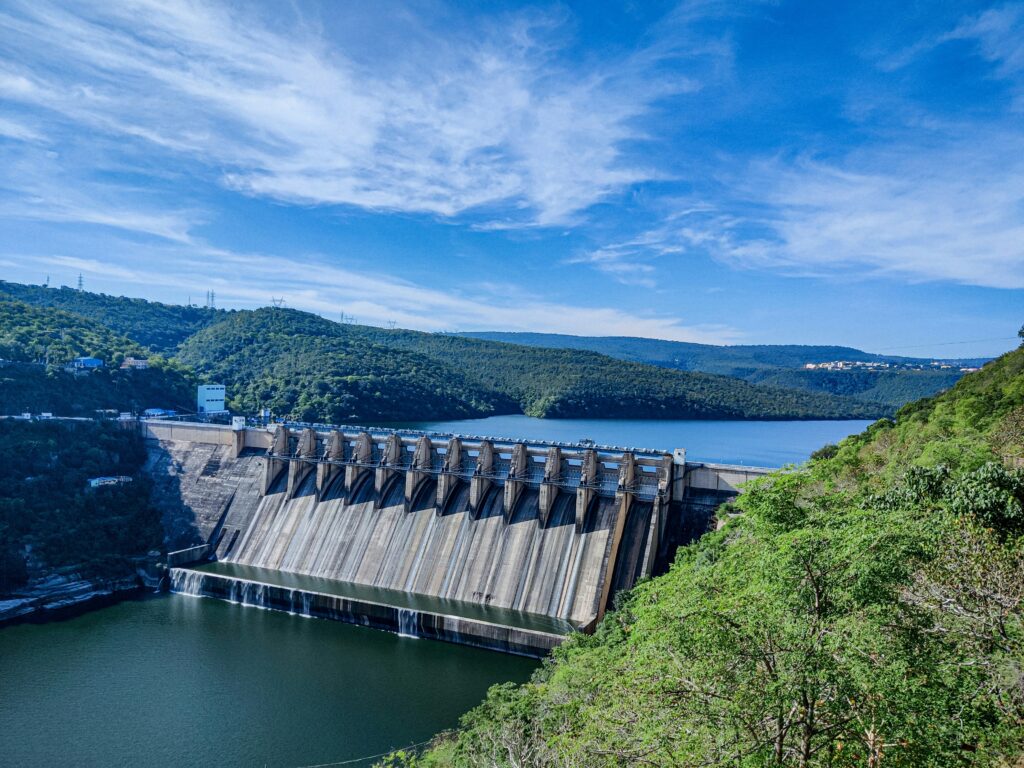
Photo by Tejj on Unsplash Srisailam Dam Reservoir
Storage hydel plants have large reservoirs created by dams that store significant volumes of water. This stored water can be released in a controlled manner to generate electricity on demand — making storage hydel the most flexible and valuable type of hydel generation for grid management. Tarbela Dam on the Indus River — 4,888MW — and Mangla Dam on the Jhelum River — 1,310MW — are Pakistan’s largest storage hydel plants. Storage hydel can respond to peak demand by increasing water release and generation output, and can reduce generation during low demand periods by storing water for later use.
2. Run of River Hydel Plants
Run of river hydel plants generate electricity directly from natural river flow without significant water storage. A weir or small diversion structure directs river water into a canal or tunnel leading to the powerhouse — the water passes through the turbines and returns to the river downstream. Generation output varies with natural river flow — higher in monsoon and snowmelt seasons, lower in dry winter months. Run of river plants have significantly lower environmental impact than storage plants — no large reservoir, minimal land submergence and less disruption to river ecosystems. Suki Kinari 884MW on the Kunhar River and Ghazi Barotha 1,450MW on the Indus River are major run of river hydel plants in Pakistan. The majority of hydel projects being developed across Southeast Asia — in Laos, Vietnam and Indonesia — are run of river designs suited to the region’s perennial river systems.
3. Pumped Storage Hydel Plants
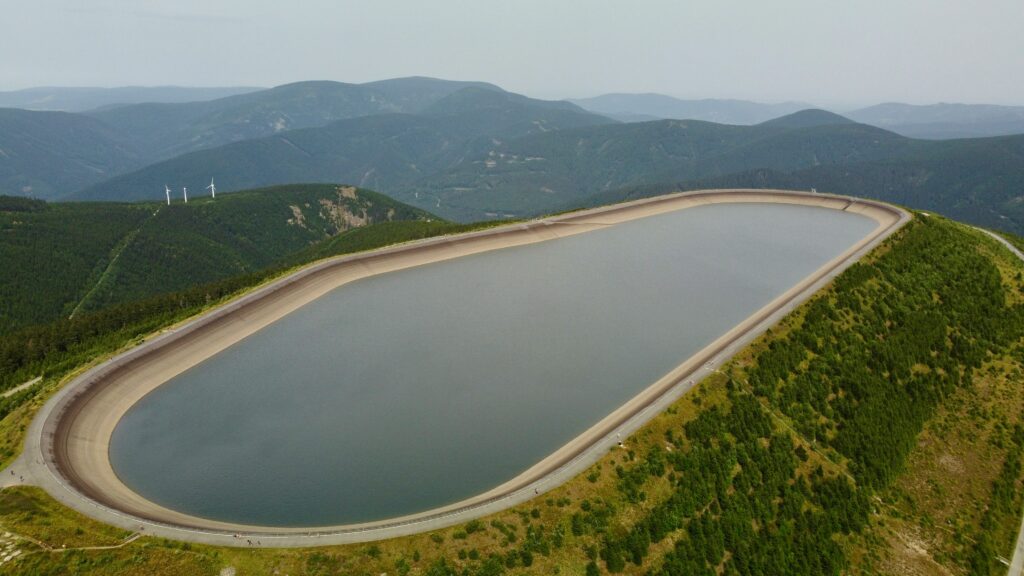
Aerial view of pumped storage hydroelectric power plant Dlouhe Strane in Czechia.Photo by Lukas Marek on Unsplash
Pumped storage hydel plants are the world’s largest energy storage technology. During periods of low electricity demand — typically at night — surplus grid electricity pumps water from a lower reservoir to an upper reservoir. During peak demand periods the stored water is released back down through turbines to generate electricity. This pumping and generating cycle effectively stores electrical energy as gravitational potential energy — acting as a giant rechargeable battery for the national grid.
Pumped storage is becoming increasingly valuable globally as grids integrate more intermittent solar and wind generation that requires balancing with reliable dispatchable storage. Pakistan currently has limited pumped storage development but the country’s mountainous terrain offers enormous potential for future pumped storage projects that could significantly improve grid stability and enable greater renewable energy integration.
4, Micro and Small Hydel Plants
Micro hydel plants — typically under 100kW — and small hydel plants — typically between 100kW and 10MW — play a critical role in rural electrification across South Asia and Southeast Asia. These smaller installations can harness the energy of small streams and irrigation channels to provide clean reliable electricity to remote communities far from national grid infrastructure. Pakistan’s mountainous northern regions — Gilgit Baltistan, AJK and KPK — have enormous potential for micro and small hydel development.
Hundreds of small streams descending from the Himalayas and Karakoram ranges offer hydel potential that could electrify remote villages at far lower cost than grid extension. The simplicity of micro hydel technology — a small weir, a short penstock, a compact turbine and generator unit — makes it deployable in remote locations with minimal civil works and local maintenance capability. Across Nepal, Bhutan, Myanmar and Indonesia micro and small hydel projects are transforming rural energy access for millions of people who have never had reliable electricity.
Hydel Energy in Pakistan — The National Picture
Pakistan has one of the most significant hydel power sectors in Asia — both in terms of existing installed capacity and future development potential. The country’s major river systems — the Indus, Jhelum, Chenab, Kabul and Kunhar fed by Himalayan and Karakoram glaciers carry enormous water volumes with significant elevation drops ideal for hydel development. Pakistan’s current installed hydel capacity stands at approximately 10,000MW across WAPDA operated plants and private sector IPP hydel projects.
WAPDA’s hydel generation recently crossed 6,100MW in a single peak output — demonstrating the sector’s growing contribution to national electricity supply. Pakistan’s assessed hydel potential exceeds 60,000MW — meaning less than 17% of the country’s hydel resource has been developed. Major projects currently under construction — Diamer Bhasha Dam at 4,500MW, Dasu Hydropower Project at 2,160MW in its first phase and Mohmand Dam at 800MW — will significantly expand Pakistan’s hydel capacity over the next decade. Hydel power is Pakistan’s cheapest electricity source at approximately Rs3.83 per unit — significantly below the cost of thermal generation — making hydel development a critical national energy security and affordability priority.
Hydel Energy Globally The Big Picture
Hydel power is the world’s largest source of renewable electricity — generating approximately 4,300 TWh annually and accounting for around 15% of global electricity production. Over 1,300GW of hydel capacity is installed worldwide across more than 150 countries. China leads global hydel development with over 400GW of installed capacity including the Three Gorges Dam — the world’s largest power station at 22,500MW. Brazil generates over 60% of its national electricity from hydel power. Norway generates over 90% of its electricity from hydel. Canada, the United States, India, Russia and Japan all have significant hydel sectors that form the backbone of their renewable energy portfolios.
The International Hydropower Association projects over 1,000GW of new hydel capacity under development globally — with the majority in Asia, Africa and South America. Southeast Asia is emerging as one of the most active hydel development regions — Laos, Vietnam, Indonesia and Myanmar all have major hydel expansion programs underway. Africa’s hydel potential remains largely untapped — the Congo River alone at Grand Inga could generate 44,000MWhttps://hydelenergy.com/grand-inga-hydropower-project/ — representing the single largest untapped hydel resource on earth.
What is Hydel Energy Field Engineer’s Perspective
After 15 years working inside hydel power projects — from early civil construction through mechanical installation, electrical commissioning and commercial operation — hydel power is not an abstract concept. It is a daily engineering reality. Standing inside an underground powerhouse cavern carved from solid rock hundreds of metres below a mountain — watching a generating unit weighing thousands of tonnes spin at synchronous speed producing hundreds of megawatts of clean electricity from river water — gives a perspective on hydel power that no textbook fully captures.
Hydel power is simultaneously the simplest and most complex energy technology ever developed. Simple in principle — water falls, turbine spins, electricity flows. Complex in execution — every component from the dam intake to the grid connection must be engineered, installed, commissioned and maintained to exact specifications for the system to function reliably for decades. Pakistan’s hydel projects — Neelum Jhelum, Suki Kinari, Tarbela, Mangla, Ghazi Barotha — represent extraordinary engineering achievements built in some of the most challenging geological and logistical environments on earth. The engineers, contractors, operators and technicians who build and run these plants deserve a knowledge platform that reflects the real complexity and significance of what they do. That is what Hydel Energy exists to provide.
Conclusion — Hydel Power Is the Foundation of Clean Energy
What is hydel power? It is the conversion of water energy into electricity — renewable, clean, reliable and generational. It is the cheapest electricity source in Pakistan at Rs3.83 per unit. It is 15% of global electricity supply from over 1,300GW of installed capacity worldwide. It is the backbone of energy systems in Norway, Brazil, Canada and dozens of other countries. It is the untapped potential of 60,000MW in Pakistan, 44,000MW at Grand Inga in DRC and hundreds of thousands of megawatts across Asia, Africa and South America waiting to be developed. It is the engineering discipline that builds underground powerhouse caverns, installs turbines weighing hundreds of tonnes, commissions generators producing hundreds of megawatts and connects clean renewable electricity to national grids serving millions of people.
Hydel power is not just an energy technology. It is the most proven, most reliable and most sustainable large scale electricity generation technology ever developed — with a track record spanning over a century and a future extending for generations to come. For engineers, developers, investors and policymakers working in the global power sector — understanding hydel power is not optional. It is essential.
Explore our complete field engineer guides on How Do Hydropower Plants Work, Hydel Power Advantages and Disadvantages, Is Hydel Energy Renewable and What Does Hydel Mean.